
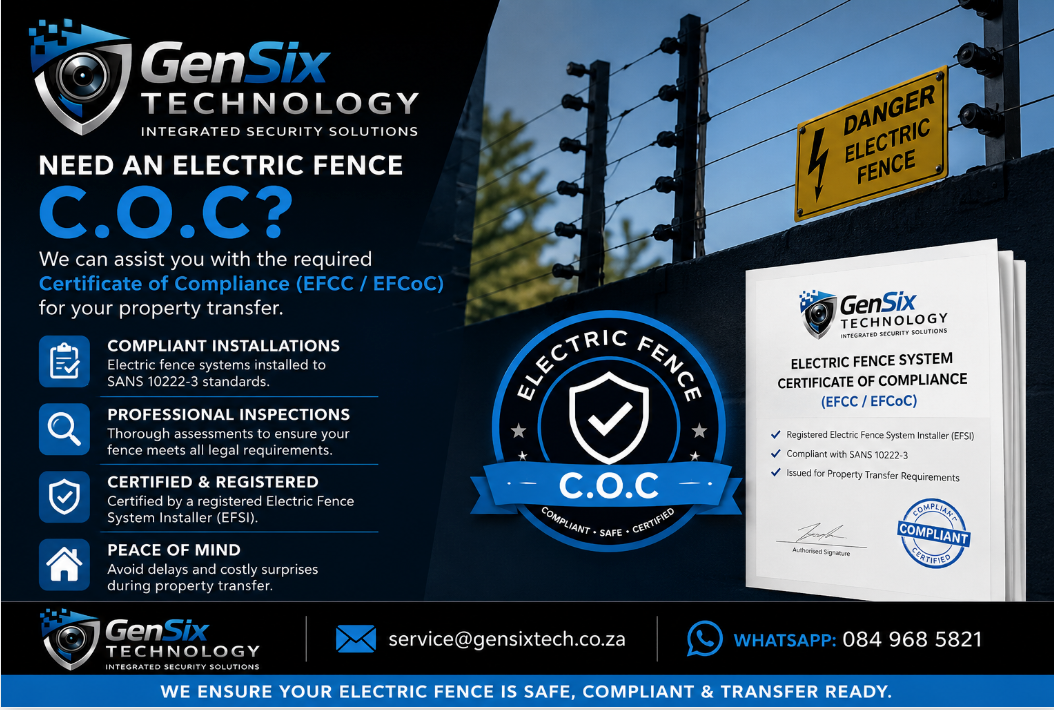
Selling a House in South Africa With an Electric Fence? Here’s What You Need to Know
A practical guide to electric fence compliance requirements during property transfer.
If you want to sell a house in South Africa that has an electric fence, one of the most commonly overlooked legal requirements is an Electric Fence System Certificate of Compliance (EFCC / EFCoC).
This certificate is required in addition to the standard Electrical Certificate of Compliance (CoC) for the property. Without it, the transfer process can be delayed, disputed, or become unnecessarily expensive during conveyancing.
1. You Need an Electric Fence Certificate of Compliance (EFCC)
If the property has an electric fence system installed, the conveyancing attorney will generally require an Electric Fence Certificate of Compliance before transfer.
This requirement falls under the Occupational Health and Safety Act (OHS Act) and the Electrical Machinery Regulations governing electric security fencing.
Many homeowners mistakenly assume that the standard electrical CoC covers the fence. It does not.
2. The Fence Must Comply With SANS Requirements
During inspection, the electric fence will typically be assessed against SANS 10222-3 compliance requirements.
The inspector will commonly assess the following:
- Correct warning signage (“Danger Electric Fence”) at required intervals
- Proper insulation and mounting of fence components
- Correct zoning and wiring practices
- Safe clearances from roofs, gates, public areas, and metal structures
- Functional energiser installation and correct earthing
- No dangerous modifications, bypasses, or DIY repairs
In practice, many properties fail compliance for relatively small issues such as:
- Missing warning signs
- Bridged or bypassed fence zones
- Exposed HT cable
- Poor earthing resulting in weak fence performance
- Improvised or non-compliant alterations
3. Only a Registered Installer Can Issue the Certificate
Not every electrician is legally qualified to certify an electric fence.
The certificate must be issued by a registered Electric Fence System Installer (EFSI) authorised to inspect and certify electric fencing systems.
4. Non-Compliant Systems Must Be Rectified First
If faults are found during inspection, rectification work is usually required before a certificate can be issued.
Common remedial work includes:
- Replacing cracked insulators
- Installing compliant warning signage
- Correcting gate bonding issues
- Improving or repairing earthing systems
- Removing unsafe joins or illegal bypasses
- Repairing fence spacing and wire tensioning
5. Who Pays for the Certificate?
In most cases, the seller pays for the electric fence compliance certificate.
However, this can be negotiated in the Offer to Purchase. Most sale agreements assign responsibility for compliance certificates to the seller.
6. The Important Nuance Around Older Fences
There is often confusion around older electric fence systems, particularly those installed before 2012.
- Fences installed after 1 October 2012 generally require certification.
- Older fences may still require certification if altered, upgraded, or during property transfer.
In reality, conveyancing attorneys often request compliance regardless because transfer risk sits with them.
Practical Advice Before Listing Your Property
One of the most common mistakes homeowners make is waiting until transfer begins before checking whether the electric fence complies.
A non-compliant fence often becomes a negotiation point for buyers and can create unnecessary delays during conveyancing.
Common “sale killers” include:
- Dead fence zones not functioning
- Energiser battery failure
- Physically damaged or bridged fence lines
- Missing legal warning signage
- Poor earthing causing low joule output
- Incorrect offsets on wall-mounted installations
A pre-sale compliance inspection is usually significantly cheaper and less stressful than emergency rectification once transfer is already underway.
Comments
Leave a Comment