
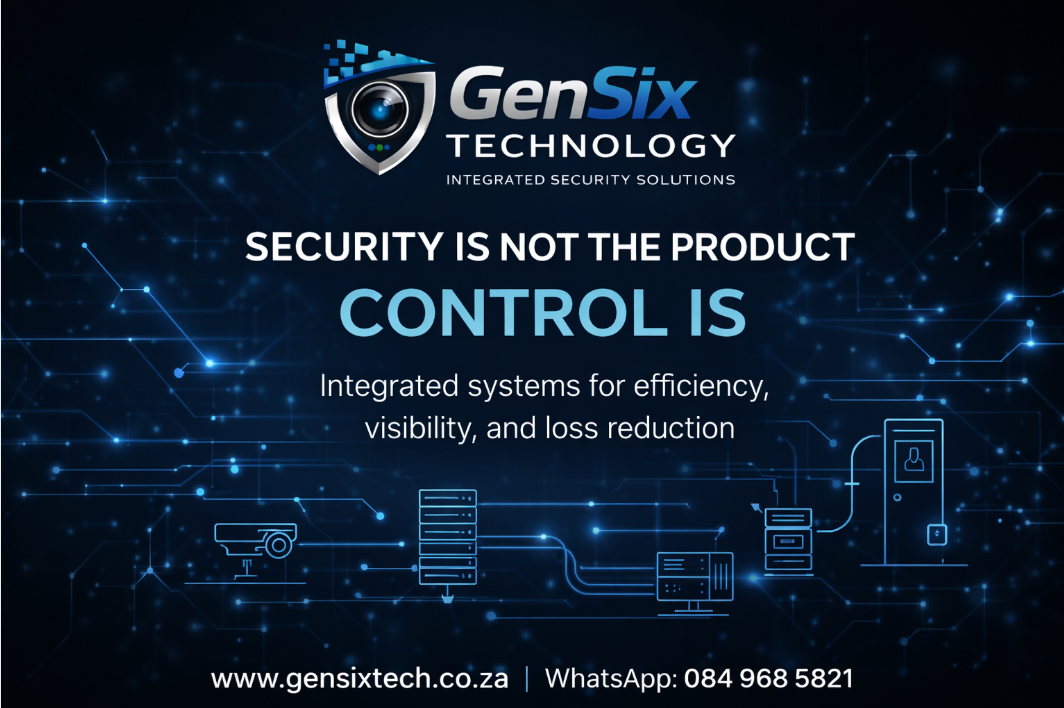
Security Is Not What You Think It Is
When most businesses hear the word security, they picture alarms, cameras, and guards. These are reactive systems designed to respond after something has already gone wrong.
But that is not what modern security should be.
What we implement today is not just "security."
It is business optimisation infrastructure.
The Traditional View: Security as a Cost Centre
In its conventional form, security is treated as an expense:
- CCTV to review incidents after the fact
- Alarm systems to notify you of breaches
- Access control to restrict entry
These systems operate in isolation. They are installed, armed, and largely forgotten until something fails or an incident occurs.
From an operational standpoint, this model has a fundamental flaw:
It does nothing to actively improve how your business runs.
The Reality: Integrated Systems Drive Operational Efficiency
What we design and deploy is fundamentally different.
By integrating network infrastructure, CCTV, access control, and monitoring systems, the result is not just protection. It is visibility and control over your operation.
1. Loss Reduction (Beyond Theft)
Loss is not limited to break-ins.
It includes:
- Process inefficiencies
- Unmonitored movement of stock
- Time abuse or poor workforce accountability
- System downtime due to poor infrastructure design
An integrated system allows you to:
- Correlate events across systems
- Identify patterns, not just incidents
- Reduce invisible operational leakage
2. Operational Visibility
Most businesses operate with blind spots.
Disconnected systems mean your data exists but it is not useful.
We design systems where:
- CCTV, access control, and network data align
- Critical systems are prioritised and segmented
- Infrastructure supports uptime, not just connectivity
You do not just see your business. You understand how it behaves.
3. Efficiency Through Infrastructure Design
Poorly designed systems create friction:
- Network bottlenecks
- Power failures affecting critical systems
- Maintenance complexity
- Limited scalability
We approach deployments as infrastructure engineering:
- Proper PoE budgeting and load distribution
- UPS-backed critical systems
- Network segmentation (VLANs)
- Structured cabinet and patching design
This reduces downtime, simplifies troubleshooting, and lowers long-term costs.
4. Risk Management, Not Just Incident Response
Traditional security reacts.
Integrated systems actively reduce risk exposure by:
- Highlighting weak points in infrastructure
- Identifying system drift
- Ensuring consistent performance under load
The conversation shifts from "What happened?" to "Where are we exposed right now?"
Why This Matters for Growing Businesses
As businesses scale, complexity increases:
- More staff
- More assets
- More movement
- Greater reliance on digital systems
Without proper infrastructure, this leads to:
- Increased losses
- Reduced accountability
- Operational inefficiencies
- Higher long-term costs
Integrated systems provide a stable foundation for growth.
Our Approach
We do not install "security systems."
We design and implement integrated operational infrastructure combining:
- Structured networking
- CCTV surveillance
- Access control systems
- Power continuity (UPS and surge protection)
Each component is engineered to work together as a unified system.
Service Area
We provide professional solutions across Durban and Pietermaritzburg, supporting small to medium commercial facilities with scalable, reliable infrastructure.
Final Thought
If your security system only tells you something went wrong, it is already too late.
The real value lies in systems that reduce loss, improve efficiency, and give you control over your operation.
That is not security. That is operational control.
Gensix Technology
Website: www.gensixtech.co.za
WhatsApp: 084 968 5821
Integrated Security and Network Infrastructure Solutions
CYPRIAN —
Well explained article.