
Facility Managers
If I had to spend time on-site at a facility today, one pattern I would expect to come up in discussion is power stability.
Loadshedding may have eased, but what remains is a more subtle layer of variability:
- Occasional voltage fluctuations
- Short, unscheduled interruptions
- Inconsistent transfer between mains and backup
- Generators that behave differently under real load
What makes this challenging is not the severity, but the unpredictability.
In many environments, this means:
- Systems do not always transition in a controlled way
- Backup capacity is not always where it is expected to be at the moment it is needed
In parallel, there are a few technical conditions that tend to surface over time:
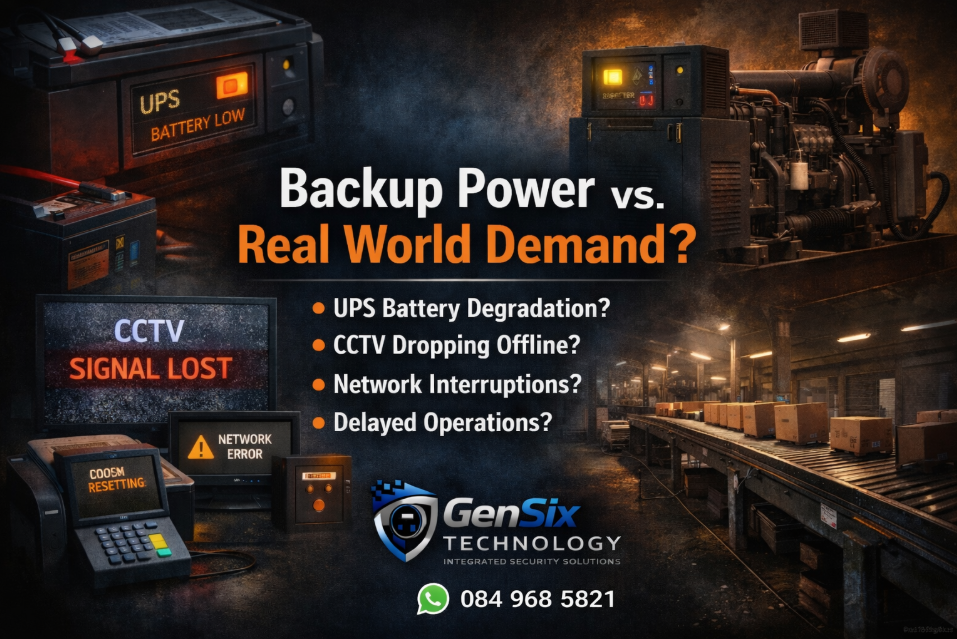
- UPS batteries naturally degrading after a few years in service
- Runtime assumptions no longer matching actual connected load
- Limited recent load testing under real conditions
- Backup systems designed without clear prioritisation of critical versus non-critical equipment
None of these are unusual. They are part of how systems evolve in live environments.
Where it becomes more interesting is how these small events show up operationally:
- Brief network interruptions affecting POS, ERP, or remote access
- CCTV systems dropping out during key moments
- Access control resets creating friction at entry points
- WiFi instability affecting day-to-day productivity
Individually, these are easy to absorb. Collectively, they start to shape how smoothly a facility operates.
Over time, that can translate into:
- Slower throughput
- Interrupted transactions
- Delays in dispatch or production cycles
- Increased exposure during moments of reduced visibility
What makes this difficult to track is that each event is short-lived. Once power is restored, operations resume and the moment passes.
But within those moments:
- Transactions are missed
- Processes are paused or reset
- Visibility is temporarily reduced
- Customer experience is affected
It is less about major outages, and more about the accumulation of small, unmeasured interruptions.
Across different facilities, there is often a natural confidence that backup systems are in place, which they are. The more nuanced question tends to be how those systems are performing under actual, current conditions.
Key Consideration
How closely does backup power performance align with real-world operational demand at the moment it is needed?
That question alone tends to surface most of the meaningful insights.
This perspective is based on observations across multiple operational facilities, where backup power systems, network infrastructure, and security platforms are assessed under real-world conditions rather than design assumptions.
In many cases, the gap between expected performance and actual behaviour only becomes visible during short, routine interruptions.
Comments
Leave a Comment